 Karney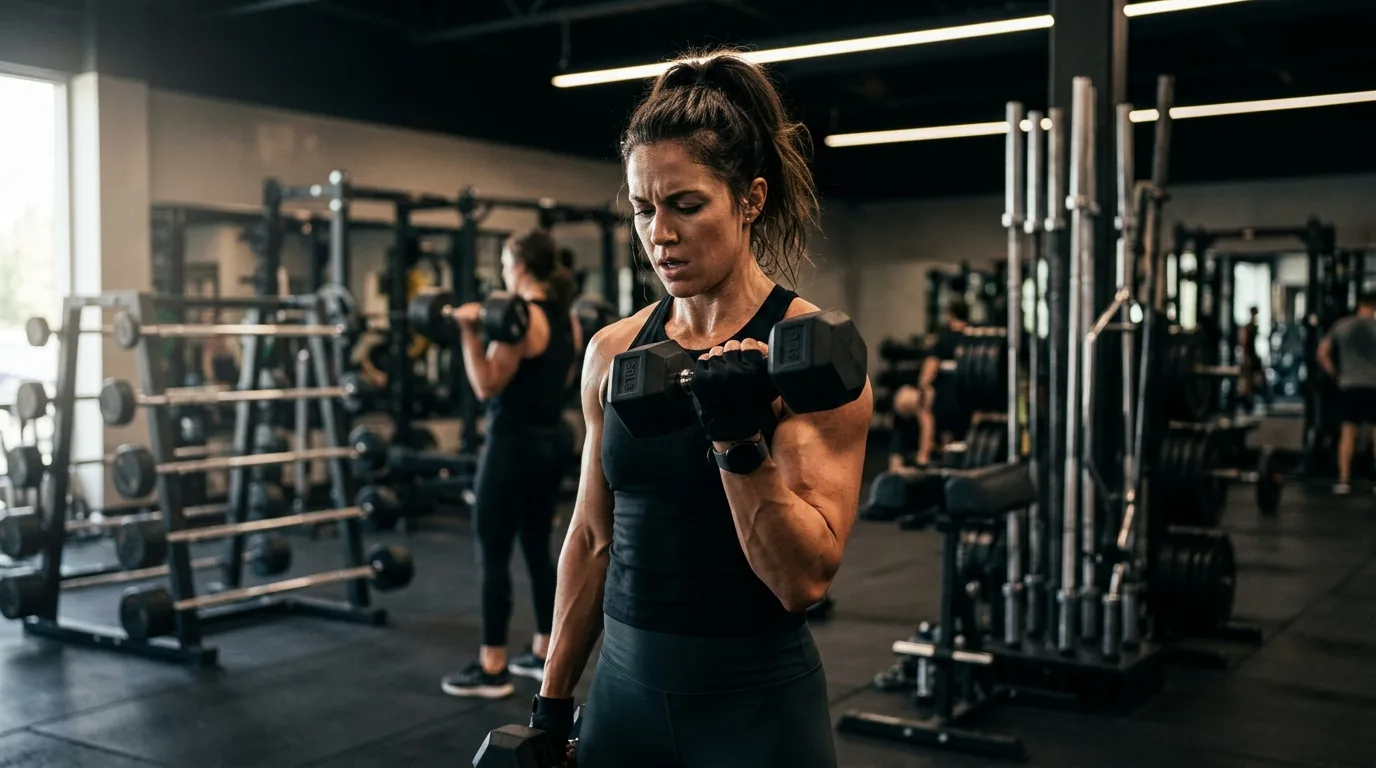
Why the Biceps Curl Is Harder to Do Right Than It Looks?
The bicep is a two-joint muscle. It crosses both the shoulder and the elbow, which means your grip, your elbow position, and your shoulder angle all affect how much tension actually lands on it. Most people grab dumbbells that are too heavy and turn the curl into a full-body heave. The result: shoulders, traps, and lower back do the work while the biceps barely fire.
The biceps brachii has two heads: the long head (outer, gives the peak you see from the front) and the short head (inner, adds overall width). Different variations load each differently. A standard standing curl hits both. An incline curl stretches and loads the long head throughout the range. A preacher curl hammers the short head at the shortened position. Knowing this lets you pick the right tool instead of just grabbing whatever is available.
The muscle underneath the bicep, the brachialis, is the most underrated piece of upper arm development. It sits between the bicep and the humerus and it accounts for a significant chunk of arm thickness. Hammer curls with a neutral grip load it directly. If your arms look flat despite consistent curling, brachialis work is almost certainly what you are skipping.
One more thing worth addressing: if you do a lot of rows and pull-ups, you might think direct biceps work is unnecessary. It is not. Compound pulls build a baseline of bicep strength, but the back is almost always the limiting factor in those movements. Your lats give out before your biceps do. Direct curls let you take the bicep to true failure without anything else fatiguing first. That is why dedicated curl work leads to faster arm development than just piling on more rows.
How to Do a Perfect Biceps Curl?
This applies to the standard standing dumbbell curl, which is where your foundation gets built.
Starting position: Stand tall, feet hip-width apart. Hold a dumbbell in each hand, palms fully supinated (facing forward). Elbows pinned close to your sides. Do not let them drift forward before you even start the rep.
The curl: Breathe in, brace your core. Curl the weight by flexing the elbow only. Your torso does not move. Your elbows stay fixed. At the top, rotate the pinky slightly upward for full supination and squeeze hard for one second. Lower over 2 to 3 seconds all the way to full elbow extension at the bottom. That bottom stretch is non-negotiable: cutting it short removes a key mechanical growth signal.
Practical weight targets: beginners, 3x12 at 15 to 20 lb per hand; intermediates, 3x10 at 30 to 35 lb. If you are using more than 40 lb and your torso is swinging, you are not building biceps, you are building ego.
For the barbell curl, stand against a wall with your head, upper back, and glutes touching it throughout the set. That single cue eliminates almost all momentum. A solid intermediate target is 3x8 at 65 to 75 lb on a straight or EZ-bar, controlled all the way up and all the way down.
The Best Biceps Curl Variations and When to Use Them?
You do not need ten variations. Pick three or four and rotate them with intention.
- Hammer Curl: neutral grip, palms facing each other. Loads the brachialis and brachioradialis hard, and it is far easier on the wrists than supinated curls. Good as your second movement each session: 3x12 at 25 to 30 lb.
- Incline Dumbbell Curl: bench set to 45 to 60 degrees, arms hanging straight behind the torso. The long head is already stretched at the start, so the entire range of motion happens under load. A humbling exercise: most lifters drop 10 to 15 lb versus their standing curl. Start with 3x10 at 18 to 22 lb and expect serious soreness the next day if this is new to you.
- Preacher Curl: upper arm pinned on the pad, swinging physically impossible. This isolates the short head with no escape. Use an EZ-bar attachment: 3x8 at 50 to 60 lb total. Slow the eccentric right down near the bottom, that is where the load on the bicep peaks.
- Cable Curl: cables maintain constant tension through the full arc of the movement, unlike free weights where tension drops near the top. Use a low pulley with a straight bar or rope: 3x15 at 35 to 45 lb on the stack. Best as a finisher after heavy work.
Do not load all four into the same session. Pick one heavier compound movement and one isolation finisher per workout. Swap the pairing every three to four weeks to keep the stimulus fresh.
How Much Weight, How Many Sets, and How Many Reps for the Biceps Curl?
Here is a practical framework without the overthinking:
- Strength focus: 4 sets of 5 to 8 reps. Rest 90 to 120 seconds. Example: barbell curl 4x6 at 75 lb. Add weight when you hit the top of the rep range on all four sets with clean form.
- Hypertrophy (most people's goal): 3 to 4 sets of 8 to 15 reps. Rest 60 to 90 seconds. Example: dumbbell curl 3x12 at 30 lb, cable curl 3x15 at 40 lb. This is the rep range where the biceps respond best to direct work.
- Volume and pump: 2 to 3 sets of 15 to 20 reps. Rest 45 to 60 seconds. Example: dumbbell curl 3x20 at 15 lb as a session finisher. Good for reinforcing the mind-muscle connection without wrecking your recovery.
Here is what a realistic 8-week progression on the barbell curl looks like: Week 1, 3x10 at 55 lb. Week 2, 3x10 at 60 lb. Week 3, 3x8 at 65 lb. Week 4, 3x8 at 65 lb again to lock in form. Week 5, 4x8 at 65 lb. Week 6, 4x8 at 67.5 lb. Week 7, deload at 2x10 with 50 lb. Week 8, test 4x6 at 70 lb. That is 15 lb added to your curl in 8 weeks with zero magic, just progressive overload applied consistently.
Progressive overload is the actual driver of growth. If you are not tracking your sets, reps, and weights every session, you are guessing. A good workout tracker removes that guesswork entirely. With Karney, you log each set in two taps and the app tracks your full progression history automatically, so you always know whether you actually improved since your last session.
The 5 Biceps Curl Mistakes You Need to Stop Making?
- Using momentum: if your torso swings on every rep, you are not training your biceps, you are training your lower back. Lower the weight by 20 to 30% and stand against a wall until the habit is gone for good.
- Incomplete range of motion: no partial reps. Go all the way up to squeeze the peak contraction, all the way down for the full stretch. Every rep of every set, no exceptions.
- Elbows drifting forward: when your elbows shoot forward during the curl, the front deltoid takes over and the bicep's effective range shortens. Keep elbows pinned to your sides from start to finish, not mostly, all the way.
- Skipping supination: the bicep supinates the forearm in addition to flexing the elbow. If you curl with a fixed neutral grip on dumbbell curls, you are leaving a big portion of the muscle's function on the table. Start neutral, rotate to pinky-up as you curl up.
- Dropping the eccentric: lowering the weight in 2 to 3 seconds produces more mechanical tension and more growth stimulus than the curl itself. Most people drop the weight after the squeeze like it is an afterthought. Slow it down. You are wasting free gains every single set.
How to Program Biceps Curls Into Your Weekly Training?
Biceps recover faster than larger muscle groups like the back or the quads. Training them twice a week is the sweet spot for most intermediate lifters.
Push/Pull/Legs split example:
- Pull Day A: Barbell curl 4x8 at 65 lb + Incline dumbbell curl 3x10 at 22 lb
- Pull Day B: Hammer curl 3x12 at 27.5 lb + Cable curl 3x15 at 40 lb
4-day upper/lower split example:
- Upper A (heavy pull focus): Barbell curl 4x6 at 70 lb after rows and pull-ups
- Upper B (moderate volume): Dumbbell curl 3x12 at 30 lb + Preacher curl 3x8 at 55 lb total
Volume target: 10 to 16 working sets per week for the biceps is a solid range for an intermediate lifter. Below 10 and you are likely undertraining. Above 20 sets and recovery becomes the bottleneck. If you have been plateaued for months, adding a second curl session with just 4 to 6 extra sets per week is often all it takes to restart growth.
Every 6 to 8 weeks, run a deload week: drop your volume by 40 to 50% while keeping loads similar. Your elbows and wrists will recover, and the biceps almost always come back fuller the following week.
Log all of this consistently and you will build a clear picture of what is working. Karney is the workout tracker that stores your full training history in one place, so you can look back at any session, spot stalls early, and make smart calls about when to push load and when to pull back.