 Karney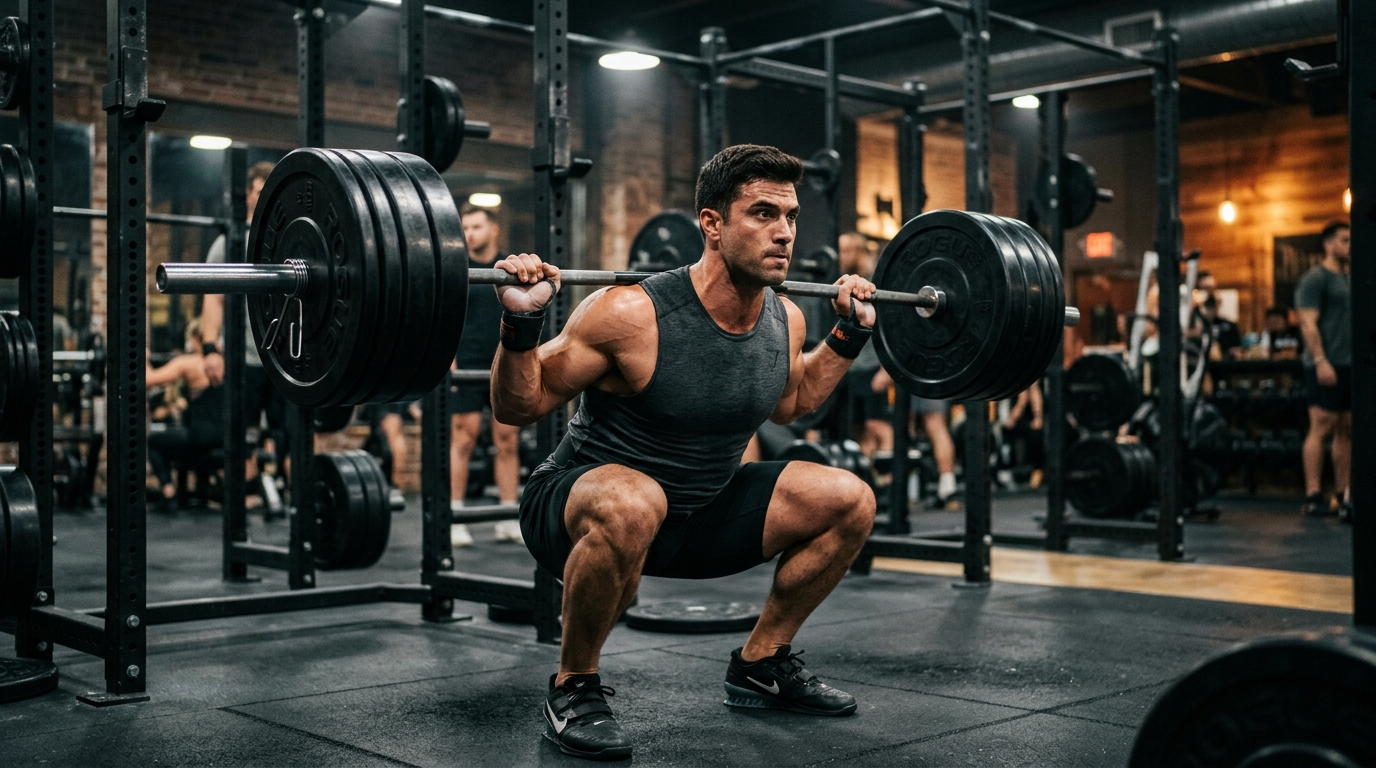
Why Most Lifters Fail to Build Legs?
The problem is almost never effort. Most people train hard enough on squat day. The problem is specificity. They hit 3x10 squats, do some leg press, call it done, and wonder why their legs refuse to grow.
Three things kill leg development consistently:
- Not enough volume per muscle group. Your quads, hamstrings, and glutes are separate muscles. Squats load all three but dominate none of them. You need targeted work for each.
- No progressive overload tracking. If you squatted 185 lb for 4x8 last week and you are squatting 185 lb today, nothing is changing in your legs, only your confidence.
- Skipping the posterior chain. Hamstrings are the most undertrained muscle in most gyms. Three sets of leg curls tacked on at the end does not count as hamstring training.
Research published in the Journal of Strength and Conditioning Research puts minimum effective weekly volume for hypertrophy at 10 direct sets per muscle group. Count your last leg session honestly. Most people are sitting at 6 to 8 sets for quads and barely 4 for hamstrings. That gap is why your legs are not growing.
The 5 Exercises You Need to Build Legs?
You do not need 15 movements. You need 5 that you actually get strong on over months. Here they are, with target numbers you can plug in immediately.
1. Back Squat
The foundation. Nothing loads the quads and glutes under full tension like a barbell squat taken to depth. Control the descent for 3 seconds, reach full depth (hip crease below the knee), and drive through the heels on the way up. Partial reps with more weight are not a trade-up.
Target: 4x6 at 70 to 75 percent of your 1RM. If your max is 225 lb, you are working at 155 to 170 lb. Rest 3 minutes between sets.
2. Romanian Deadlift
This is the hamstring builder most people ignore. Hinge at the hip, keep the bar close to your legs, and lower until you feel a strong stretch in the hamstrings, not until your lower back rounds. The stretch is the stimulus.
Target: 3x10 at 135 to 185 lb depending on your training age. Rest 2 minutes. Do not rush this one.
3. Leg Press
Takes the lower back out of the equation and lets you load the quads directly. Feet at shoulder width, low on the platform means more quad involvement. High and wide means more glutes and adductors. Pick your weak point and position accordingly.
Target: 4x12 at a load where the last 2 reps are genuinely difficult. If you can finish the set talking, the weight is too light.
4. Walking Lunges
Unilateral work fixes left-right imbalances and adds a loaded stretch that bilateral movements simply cannot replicate. Twenty steps with dumbbells is more honest work than it looks.
Target: 3x20 steps at 30 to 50 lb dumbbells. Keep your torso upright and knee tracking over the second toe.
5. Lying Leg Curl
Hamstrings have two jobs: hip extension and knee flexion. The Romanian deadlift covers hip extension. The leg curl covers knee flexion. You need both to build legs that are developed on both sides of the thigh. Neglect this and your hamstrings will always lag.
Target: 3x12 at a tempo of 2 seconds up, 3 seconds down. The slow eccentric is where most of the growth stimulus lives.
How to Structure Your Leg Day to Build Legs Consistently?
Here is a complete session you can run today with rest times included:
- A1. Back Squat: 4x6 at 70 percent 1RM, rest 3 minutes
- A2. Romanian Deadlift: 3x10 at 155 lb, rest 2 minutes
- B1. Leg Press: 4x12 at hard effort, rest 90 seconds
- B2. Walking Lunges: 3x20 steps at 35 lb dumbbells, rest 90 seconds
- C1. Lying Leg Curl: 3x12 at controlled tempo, rest 60 seconds
Total working sets: 17. That is enough volume to drive hypertrophy without leaving you unable to walk for four days. The session should take 55 to 70 minutes at a focused pace.
If you train four days a week, run this session on Day 1 and again on Day 3. On the second session, reduce squat intensity to 60 percent of your 1RM and add one extra set to the accessories. This gives you a simple high-low split without overcomplicating the week.
Track every set. You need to know exactly what you lifted last week to know whether you are progressing this week. With Karney, you log each set in 2 taps and the app tracks your weekly volume automatically so you never have to guess whether you are ahead or behind on your targets.
Progressive Overload: The Only Rule That Actually Builds Leg Size?
Leg size does not come from variety or from switching exercises every three weeks. It comes from doing demonstrably more over time. Progressive overload means one of the following every session:
- More weight on the same sets and reps
- More reps at the same weight
- More sets at the same intensity
- Less rest for the same total volume
Pick one variable to push each week. Do not try to progress everything at once, you will stall everything at once instead.
The cleanest model for intermediate lifters is double progression. Set a rep range, say 4x8 to 4x10. Start at the bottom of the range. Each session, add reps until you hit the top. Once you hit 4x10, add 5 lb and restart at 4x8.
Here is what that looks like on the squat across four weeks:
- Week 1: 4x8 at 185 lb
- Week 2: 3 sets of 9, 1 set of 8 at 185 lb
- Week 3: 4x10 at 185 lb
- Week 4: 4x8 at 190 lb
Not glamorous. Not complicated. Exactly what works when you stick to it for 12 to 16 weeks.
Training Frequency and Recovery for Leg Growth?
One leg day per week is not enough for intermediate lifters who want real size. Muscle protein synthesis peaks at 24 to 48 hours post-training and returns to baseline by 72 hours. Training legs once every seven days means you are triggering that growth window once when you could trigger it twice.
Two leg sessions per week is the standard for anyone past the beginner stage. Advanced lifters can push to three, but recovery becomes the hard ceiling fast.
Between sessions, three things matter:
- Sleep: 7 to 9 hours minimum. Leg training creates significant systemic fatigue, not just local quad soreness. Sleep is when the adaptation happens.
- Protein: 0.7 to 1 gram per pound of bodyweight per day. For a 180 lb lifter, that is 126 to 180 grams daily. Hit this consistently, not just on training days.
- Light movement: A 15-minute walk on off days accelerates recovery faster than complete rest. The increased blood flow clears waste products and reduces delayed onset soreness.
If your legs are still significantly sore 96 hours after training, you are either doing too much volume or under-recovering. Cut weekly sets by 20 percent, fix sleep and protein, then rebuild over three to four weeks. Adding more volume on top of incomplete recovery does nothing.
The Mistakes That Kill Your Leg Gains?
Let's be direct about what holds most people back, because the same five mistakes show up constantly.
Mistake 1: Treating Leg Day Like Cardio?
High reps, low weight, 30-second rest periods. Your legs are the largest muscle group in your body. They respond to heavy, progressive work. If you are doing 4x20 with a weight you could do 40 reps with, you are building endurance, not size. Respect the weight.
Mistake 2: Ignoring the Posterior Chain?
Quad-dominant training leaves hamstrings and glutes chronically underdeveloped. Beyond the aesthetic imbalance, this creates real injury risk at the knee. Romanian deadlifts and leg curls are not optional finishers. They are half your leg program.
Mistake 3: Changing Exercises Every Few Weeks?
Muscle confusion is not a training strategy. Your legs grow when you get stronger on specific movements over months. Pick your five core exercises, run them for 12 weeks, measure what changed. Then adjust from evidence, not boredom.
Mistake 4: Not Tracking Your Lifts?
This is the single most common and most damaging mistake. If you do not know what you lifted last session, you cannot know whether you are progressing. A reliable workout tracker removes this completely. Karney is built for exactly this: open the app, find last week's squat session, and beat it by one rep or 5 lb. That feedback loop is what drives consistent leg growth.
Mistake 5: Skipping the Warm-Up?
Cold quads under a heavy barbell is a reliable way to pull something. Before your first working squat, spend 8 minutes on bodyweight squats, leg swings, hip circles, and two warm-up sets at 40 to 50 percent of your working weight. That is all you need. No 30-minute activation routines, just enough to have blood in the tissue before you load it.