 Karney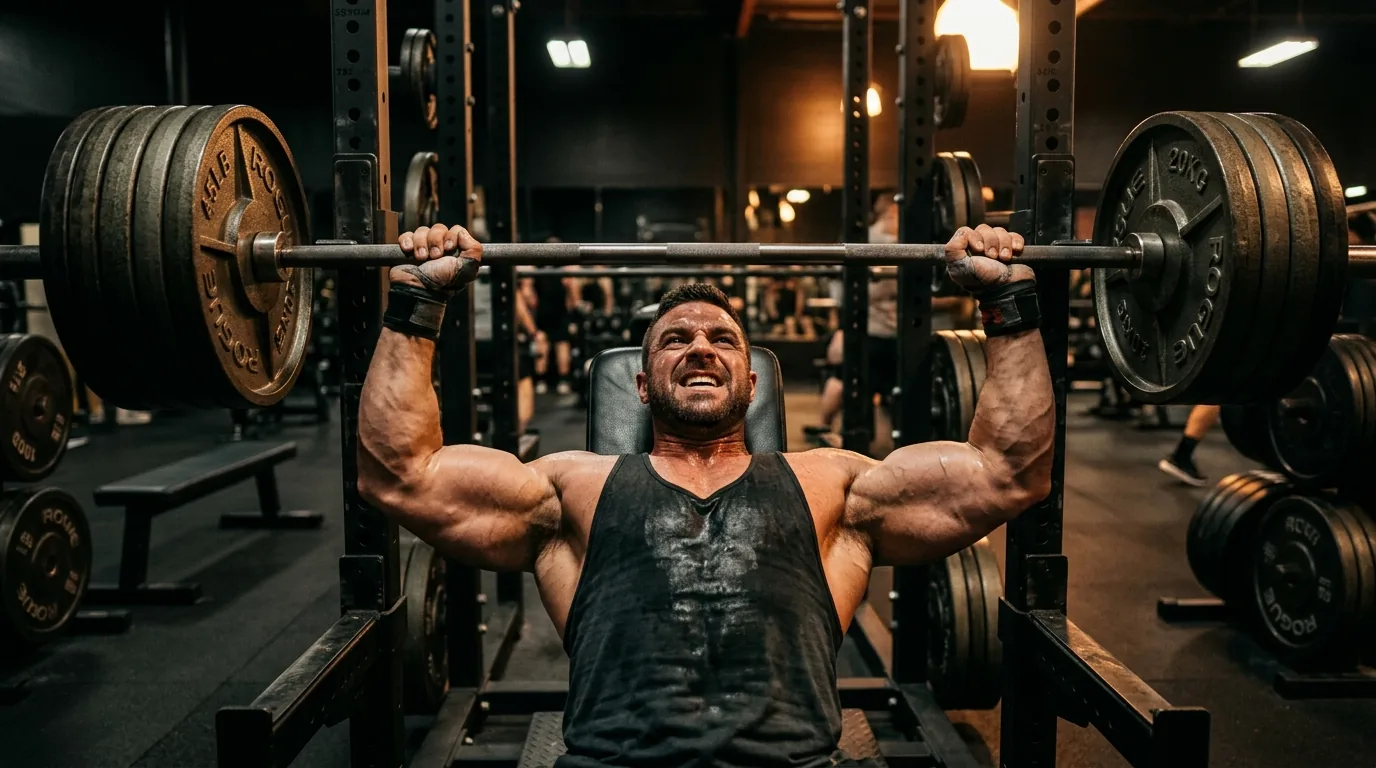
Why Most Chest Days Fail to Build Chest
Here's the honest answer: you're probably not progressive overloading, your weekly volume is too low or too scattered, and you're doing too much flat bench while neglecting the upper pec entirely. Monday chest day is a meme for a reason — it's usually 4 sets of flat bench, some cable flyes, and a protein shake. That routine stops building anything after the first six months.
Three root causes kill chest growth:
- No tracking, no overload. If you did 4×8 at 155 lb last week and you're doing the same this week, nothing changes. Period.
- Ignoring the upper chest. The clavicular head is notoriously underdeveloped in most trainees because flat pressing barely touches it. You need dedicated incline work.
- Skipping the stretch position. Chest fibers generate more force under load when they're lengthened. Dumbbell pressing and cable flyes exploit this. A barbell alone doesn't.
Fix these three and you'll grow more chest in 12 weeks than you did in the past two years.
Know Your Chest Before You Train It
You don't need a physiology degree, but understanding two things helps you program smarter.
Your pec major has two distinct heads:
- Clavicular head (upper pec): runs from your collarbone downward. Incline pressing and high-to-low cable movements hit it hardest. This is the part that makes your chest look full when you're standing, not just when you're lying on a bench.
- Sternocostal head (mid and lower pec): the large mass below. Flat and decline pressing primarily works here, along with low-to-high cable flyes for the lower fiber tie-in.
Fiber angle matters because muscles pull in the direction of their fibers. An incline bench at 30–45 degrees shifts tension toward the clavicular head. Flat or slight decline shifts it lower. Most trainees overload the lower head and underload the upper — then wonder why their chest looks flat from the side.
Practical takeaway: every chest session needs at least one incline movement and one stretch-focused movement. Non-negotiable.
The 5 Best Exercises to Build Chest
Not every chest exercise is worth your time. Here's the shortlist that actually moves the needle:
- Barbell flat bench press. The best tool for overloading the mid and lower pec with heavy compound stimulus. Work in the 5–8 rep range and track your progression every single session.
- Incline dumbbell press (30–45°). Upper pec priority, greater ROM than a barbell incline, and independent arm movement that self-corrects imbalances. Aim for 8–12 reps per set.
- Low-to-high cable fly. Constant tension throughout the movement, excellent for the upper chest tie-in. Sets of 12–15 work best — no heavy grinding on cable exercises.
- Chest dip with forward-lean torso. Underrated. Lean 20–30 degrees forward to bias the pec over the triceps. Add weight once you can hit 12 clean bodyweight reps. Outstanding for lower chest thickness.
- Incline machine press or Smith machine incline. Ideal for your second session of the week when fatigue is higher. Train safely close to failure without needing a spotter.
Pick three or four per session. You don't need all five every workout — you need each to show up consistently across the week.
The Chest Program: Sets, Reps, and Exact Loads
Here's a two-day chest split you can plug into any push-pull-legs or upper/lower program:
Day 1 — Strength Focus
- Flat barbell bench press: 4×5–8 @ RPE 8 (example: 185 lb for a lifter with a ~215 lb max)
- Incline dumbbell press: 3×8–10 (70 lb DBs)
- Weighted chest dip: 3×8–10 (+25 lb)
- Low cable fly: 2×12–15 (20 lb per side)
Day 2 — Hypertrophy Focus
- Incline barbell or Smith press: 4×10–12 (135–155 lb)
- Flat dumbbell press: 3×12–15 (60 lb DBs)
- High-to-low cable fly: 3×12–15 (30 lb per side)
- Incline machine press: 2×15–20 (close to failure, to finish)
Total weekly volume: 17–20 sets across two sessions. That's the sweet spot for most intermediate lifters. Beginners can start at 10–12 sets and ramp up progressively over 4–6 weeks.
With Karney — the workout tracker built for lifters who actually log their sessions — you record each set in two taps. The app auto-computes your estimated 1RM after every bench session and tallies your total weekly chest volume so you never have to do the math manually.
Progressive Overload: The Only Rule That Actually Matters
Your pecs don't grow because you showed up. They grow because you gave them a reason to. Progressive overload is that reason — and it only works if you track it.
Use double progression: pick a rep range (say 3×8–10) and hold the same weight until you hit the top end for all sets. Then add 5 lb and reset at the bottom of the range.
Example: flat bench at 155 lb.
- Week 1: 3×8 @ 155 lb
- Week 2: 3×9 @ 155 lb
- Week 3: 3×10 @ 155 lb — bump to 160 lb
- Week 4: 3×8 @ 160 lb — cycle continues
This method works because every weight jump is tied to demonstrated capacity. You're never grinding a load you can't handle cleanly, and you always know exactly when to move up.
The hard truth most people ignore: if you're not logging your sets, you're guessing. Guessing doesn't build chest. Data does.
Frequency, Recovery, and Weekly Volume
Training chest once a week is a 1990s bodybuilder relic. The evidence is clear: two weekly sessions beats one for hypertrophy, and three can work if volume is distributed correctly.
Why? Muscle protein synthesis peaks roughly 24–36 hours post-training and returns to baseline by 48–72 hours. Train chest once a week and you miss six days of potential growth stimulus. Train it twice and you get two MPS peaks per week with the same total effort.
The practical numbers:
- Minimum effective frequency: 2× per week
- Volume for beginners: 10–12 sets per week
- Volume for intermediates: 14–20 sets per week
- Maximum adaptive volume: around 22–24 sets per week before recovery suffers
- Rest between sessions: at least 48 hours
If you're running a 4-day upper/lower split, you already hit chest twice. Just make sure it's prioritized first in each session — don't bench after your shoulders and triceps are already cooked from earlier work.
Chest Mistakes That Are Silently Killing Your Gains
Even with the right program, these errors quietly wreck progress:
Partial reps. Quarter-pressing 225 lb impresses nobody. A full rep means the bar touches your chest under control and you lock out at the top. Partial reps slash your range of motion and eliminate time under tension at the stretch position — exactly where chest growth happens.
Elbows too flared. At 90 degrees, flared elbows compromise your shoulder and shift tension onto the anterior deltoid. Tuck your elbows to 45–75 degrees from your torso. The difference in pec activation is immediate and significant.
Grinding to failure every set. Failure has its place — last set of an isolation finisher. But going to absolute failure on compounds every session burns out your CNS and tanks recovery. Leave 1–2 reps in reserve on most sets. Save failure for your cable flyes at the end.
Rushing the eccentric. The lowering phase is where most muscle damage — and growth stimulus — occurs. Take 2–3 seconds to lower the bar. Don't bounce off your chest to cheat reps.
Zero incline work. If your program has no incline pressing, your upper chest will stay flat no matter how much flat bench volume you accumulate. One incline movement per session, minimum. That's the floor, not the ceiling.