 Karney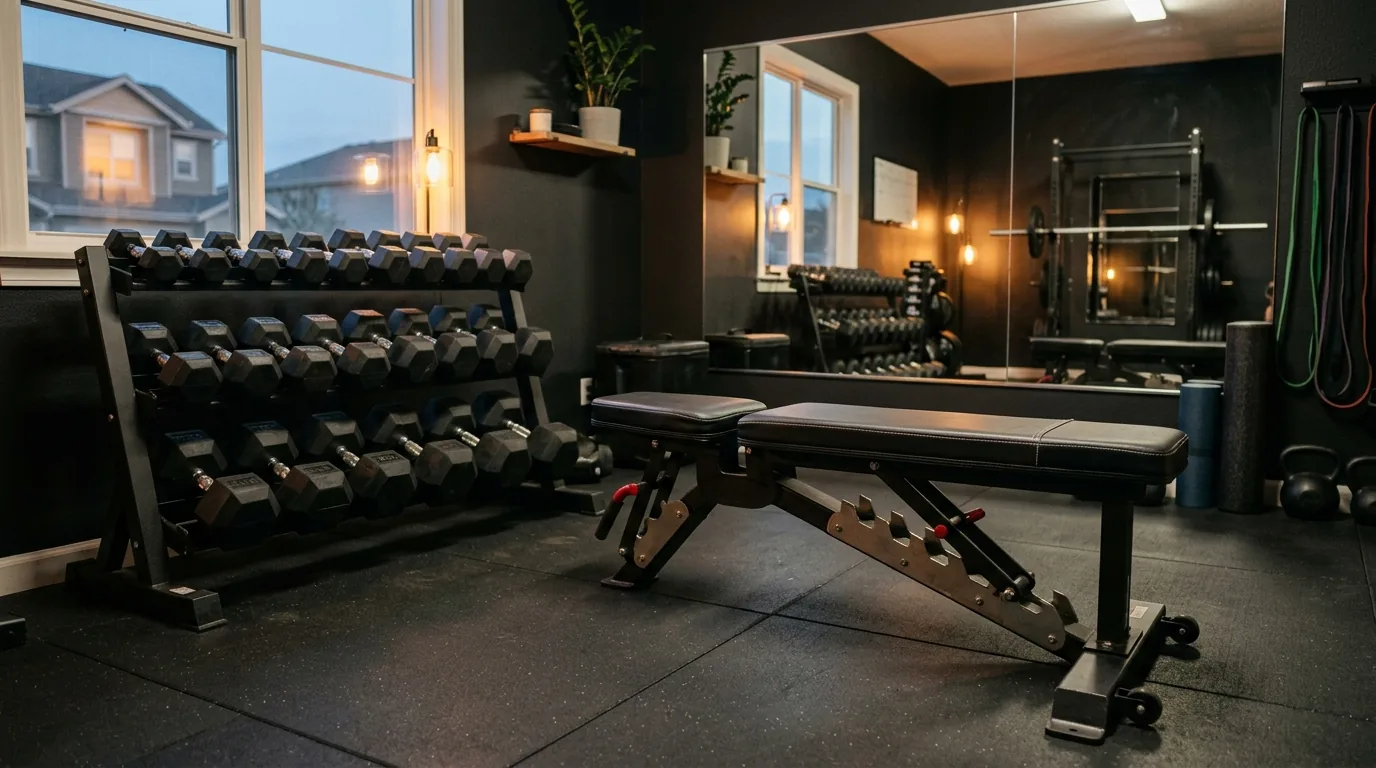
Flat, Adjustable, or FID: Which Type Fits Your Training?
Three main categories exist, and picking wrong costs you either money or versatility.
Flat bench — fixed at 0°, usually the most rigid and the cheapest. If you squat in a power rack and bench heavy with a barbell three times a week, this is all you need. A quality flat bench like the Rogue Flat Utility Bench 2.0 or Rep Fitness flat bench ($200–$300) will outlast most adjustable options at the same price. No moving parts means nothing breaks.
Fixed-position adjustable bench — three to five preset angles, typically 0°, 30°, 45°, and 90°, sometimes -15° decline. More versatile than flat, less than FID. Price range: $150–$350. The weak point: the backrest latch on budget models loosens over time and starts slipping at steep angles mid-set. Check reviews specifically for this.
FID bench (Flat/Incline/Decline) — the gold standard for a home gym. Usually 11 to 14 angle settings from -20° to 85°. You can hit 30° incline dumbbell press, 45° single-arm rows, 85° shoulder press, and Bulgarian split squats all on one piece of kit. Costs more ($300–$700+) but effectively replaces multiple benches. If dumbbells are your main tool, go FID without hesitation.
Bottom line: barbell-dominant training with a power rack → flat bench. Dumbbell-heavy, varied program → FID. Mixed but budget-constrained → fixed adjustable.
Weight Capacity and Frame Stability: The Numbers That Actually Matter
Every bench lists a weight capacity. Most manufacturers inflate it.
A bench rated at "1,000 lb capacity" refers to static load — a weight sitting still on a level surface under ideal conditions. It does not reflect the dynamic load of unracking 315 lb and lowering it to your chest under muscular tension. The real-world number is meaningfully lower.
What to check instead:
- Steel gauge: 11-gauge minimum. 14-gauge is too thin for anything over 200 lb of working weight. Lower gauge number = thicker steel = stronger frame. Commercial benches often use 7-gauge.
- Frame design: Wide four-leg bases with rubber feet beat two-leg sawhorse designs every time. The rear legs should sit behind the pad, not directly underneath it — the difference between a bench that tips and one that stays planted.
- Upright posts for adjustable models: Look for ladder-style or pop-pin adjustment mechanisms with reinforced steel inserts at each angle point. Thin plastic inserts fail.
- Wobble under load: Before buying any specific model, search YouTube for "[model name] wobble test" or "[model name] under load." Any visible lateral movement at 225 lb is a dealbreaker for serious pressing.
Practical thresholds: pressing up to 185 lb for sets of 8–12 → most benches in the $150+ range are fine. Working up to 4×5 at 275 lb → you need 11-gauge steel, a static rating above 600 lb, and a frame width of at least 24 inches at the base. Chasing 315+ lb singles → spend $400 minimum and get the commercial build.
Pad Thickness, Foam Density, and Width: Do Not Skip This Section
You will press your upper back and scapulae into this pad thousands of times. It matters more than the color.
Thickness: 2 to 3 inches of high-density foam is the target range. Under 2 inches and you feel the metal frame through the pad by your third work set. Over 3.5 inches and your upper back sinks in, your scapulae cannot retract and depress properly, your arch collapses, and your bench press mechanics fall apart. This is not theory — it is basic biomechanics.
Foam density: High-density foam holds its shape under repeated loading. Low-density foam permanently deforms in six months of regular use. Test: press your thumb firmly into the pad center and hold for two seconds. If the indent remains visible after you pull your thumb away, the foam is too soft. Good pads spring back immediately.
Cover material: Double or triple-stitched vinyl handles sweat and regular use without cracking along seams. Single-stitched seams split. Some premium benches use DuraFirm or genuine leather — nice, not necessary. What matters more than material is stitch count and seam reinforcement at the edges where stress concentrates.
Width: 10 to 12 inches is the standard for benching. Wider than 12 inches restricts scapular movement — your shoulder blades cannot retract fully, which kills your pressing power and puts the shoulder in a compromised position. Narrower than 10 inches feels unstable when you are moving heavy dumbbells into position.
Price Tiers: What $150, $350, and $600 Actually Get You
$100–$200 range: Entry-level adjustable or basic flat bench. Static capacity around 300–400 lb. Pad typically 1 to 1.5 inches, 14-gauge steel frame, limited angle options. Functional for bodyweight movements, light dumbbell work up to 50 lb per hand, beginner barbell pressing under 135 lb. Not built for sustained heavy use. The Fitness Reality 1000 (~$130) is the go-to example — it gets the job done for someone just starting out, but expect to replace it within two years of serious training.
$200–$400 range: Where most home gym lifters should be shopping. 11-gauge steel frame, 2-inch pad, static capacity around 500–700 lb, solid adjustment mechanisms that hold angle under load. Representative picks: Rep Fitness AB-3000 FID (~$299) and the Rogue Flat Utility Bench 2.0 (~$295 flat only). The Rep AB-3000 is one of the most recommended FID benches in this price tier specifically because it shows minimal wobble under 315 lb in real-world testing. If you are running a structured program — say, 5/3/1 or any periodized strength block — and logging every session in a workout tracker like Karney, this tier handles everything you will throw at it for years.
$400–$700+ range: Semi-commercial to commercial grade. Powder-coated 11-gauge or 7-gauge steel, 2.5 to 3 inch high-density pad, 1,000+ lb static rating, reinforced angle locking, often lifetime frame warranty. Representative picks: Rogue Adjustable Bench 2.0 (~$595), Rep Fitness AB-5200 (~$499), and the Sorinex Competition Bench (~$650+). This tier is built for daily use, multiple users, and decades of loading. If you are pressing north of 315 lb consistently or training six days a week with high volume, this is where you end up eventually. Better to start here than replace a mid-tier bench in three years.
Space, Footprint, and Storage
A standard flat bench runs 48 to 52 inches long and 18 to 24 inches wide. An adjustable bench set to 90° (fully upright) adds vertical height and sometimes extends the rear footprint by another 12 inches.
Measure your power rack internal depth before buying. Standard home power racks have 24 to 48 inches of usable interior space between uprights. Your bench needs to fit inside with 4 to 6 inches of clearance behind the rear uprights so you can safely unrack and rerack. This eliminates more benches than people expect.
Vertical storage: some FID benches fold upright to reduce floor space — useful if your gym shares space with a car. Always check both the flat dimensions and the folded dimensions. A bench that is 50 inches flat might be 20 inches footprint when stored upright.
Weight of the bench: mid-tier benches weigh 60 to 100 lb. If you rearrange your training space frequently or need to store the bench between sessions, factor in that moving 90 lb on carpet is not a one-handed job.
Assembly Quality, Warranty, and Red Flags in Product Listings
Most benches ship in flat-pack form. Assembly takes 20 to 45 minutes. Read reviews specifically mentioning assembly — stripped bolt threads, misaligned frame holes, and missing hardware are recurring issues on budget models and occasionally on premium ones too. If three separate reviewers mention stripped bolts, believe them.
Warranty as a quality signal: Budget tier = 1-year frame, 90-day parts. Mid-tier = 10-year frame, 2-year upholstery. Commercial grade = lifetime frame warranty. Rogue's warranty policy on frame and welds is unusually strong for the home gym market and reflects actual confidence in build quality.
Red flags to ignore or run from:
- Capacity listed as "2,000 lb" with no static/dynamic distinction — usually marketing fiction
- Pad described as "memory foam" — memory foam permanently deforms under repeated barbell loading
- No frame steel gauge mentioned anywhere in the spec sheet
- Only one leg-width configuration with no rubber feet
- Adjustment mechanism described as "easy tool-free" without showing the actual latch design in photos
One practical habit: once you have your bench set up and start training on it, track your pressing numbers from day one. With Karney, you log each set in two taps — weight and reps — and the app calculates your estimated 1RM automatically. When that number climbs consistently over 8 to 12 weeks, you know your programming is working. When it stalls, you have the data to diagnose why.